|
Z3
|


|
All Data Structures Namespaces Files Functions Variables Typedefs Enumerations Enumerator Properties Friends Defines
|
Z3
|
|
Quantifiers. More...
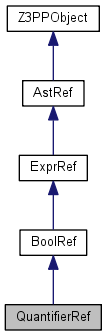
 Inheritance diagram for QuantifierRef:
Public Member Functions | |
| def | as_ast |
| def | get_id |
| def | sort |
| def | is_forall |
| def | weight |
| def | num_patterns |
| def | pattern |
| def | num_no_patterns |
| def | no_pattern |
| def | body |
| def | num_vars |
| def | var_name |
| def | var_sort |
| def | children |
Quantifiers.
Universally and Existentially quantified formulas.
| def as_ast | ( | self | ) |
| def body | ( | self | ) |
Return the expression being quantified.

>>> f = Function('f', IntSort(), IntSort())
>>> x = Int('x')
>>> q = ForAll(x, f(x) == 0)
>>> q.body()
f(Var(0)) == 0
Definition at line 1703 of file z3py.py.
Referenced by QuantifierRef.children().
01703
01704     def body(self):
01705         """Return the expression being quantified.
01706
01707         >>> f = Function('f', IntSort(), IntSort())
01708         >>> x = Int('x')
01709         >>> q = ForAll(x, f(x) == 0)
01710         >>> q.body()
01711         f(Var(0)) == 0
01712         """
01713         return _to_expr_ref(Z3_get_quantifier_body(self.ctx_ref(), self.ast), self.ctx)
| def children | ( | self | ) |
Return a list containing a single element self.body()

>>> f = Function('f', IntSort(), IntSort())
>>> x = Int('x')
>>> q = ForAll(x, f(x) == 0)
>>> q.children()
[f(Var(0)) == 0]
Reimplemented from ExprRef.
| def get_id | ( | self | ) |
| def is_forall | ( | self | ) |
Return `True` if `self` is a universal quantifier.

>>> f = Function('f', IntSort(), IntSort())
>>> x = Int('x')
>>> q = ForAll(x, f(x) == 0)
>>> q.is_forall()
True
>>> q = Exists(x, f(x) != 0)
>>> q.is_forall()
False
Definition at line 1635 of file z3py.py.
01635
01636     def is_forall(self):
01637         """Return `True` if `self` is a universal quantifier.
01638
01639         >>> f = Function('f', IntSort(), IntSort())
01640         >>> x = Int('x')
01641         >>> q = ForAll(x, f(x) == 0)
01642         >>> q.is_forall()
01643         True
01644         >>> q = Exists(x, f(x) != 0)
01645         >>> q.is_forall()
01646         False
01647         """
01648         return Z3_is_quantifier_forall(self.ctx_ref(), self.ast)
| def no_pattern | ( | self, | |
| idx | |||
| ) |
Return a no-pattern.
Definition at line 1697 of file z3py.py.
01697
01698     def no_pattern(self, idx):
01699         """Return a no-pattern."""
01700         if __debug__:
01701             _z3_assert(idx < self.num_no_patterns(), "Invalid no-pattern idx")
01702         return _to_expr_ref(Z3_get_quantifier_no_pattern_ast(self.ctx_ref(), self.ast, idx), self.ctx)
| def num_no_patterns | ( | self | ) |
Return the number of no-patterns.
Definition at line 1693 of file z3py.py.
Referenced by QuantifierRef.no_pattern().
01693
01694     def num_no_patterns(self):
01695         """Return the number of no-patterns."""
01696         return Z3_get_quantifier_num_no_patterns(self.ctx_ref(), self.ast)
| def num_patterns | ( | self | ) |
Return the number of patterns (i.e., quantifier instantiation hints) in `self`.

>>> f = Function('f', IntSort(), IntSort())
>>> g = Function('g', IntSort(), IntSort())
>>> x = Int('x')
>>> q = ForAll(x, f(x) != g(x), patterns = [ f(x), g(x) ])
>>> q.num_patterns()
2
Definition at line 1663 of file z3py.py.
01663
01664     def num_patterns(self):
01665         """Return the number of patterns (i.e., quantifier instantiation hints) in `self`.
01666
01667         >>> f = Function('f', IntSort(), IntSort())
01668         >>> g = Function('g', IntSort(), IntSort())
01669         >>> x = Int('x')
01670         >>> q = ForAll(x, f(x) != g(x), patterns = [ f(x), g(x) ])
01671         >>> q.num_patterns()
01672         2
01673         """
01674         return int(Z3_get_quantifier_num_patterns(self.ctx_ref(), self.ast))
| def num_vars | ( | self | ) |
Return the number of variables bounded by this quantifier.

>>> f = Function('f', IntSort(), IntSort(), IntSort())
>>> x = Int('x')
>>> y = Int('y')
>>> q = ForAll([x, y], f(x, y) >= x)
>>> q.num_vars()
2
Definition at line 1714 of file z3py.py.
01714
01715     def num_vars(self):
01716         """Return the number of variables bounded by this quantifier.
01717
01718         >>> f = Function('f', IntSort(), IntSort(), IntSort())
01719         >>> x = Int('x')
01720         >>> y = Int('y')
01721         >>> q = ForAll([x, y], f(x, y) >= x)
01722         >>> q.num_vars()
01723         2
01724         """
01725         return int(Z3_get_quantifier_num_bound(self.ctx_ref(), self.ast))
| def pattern | ( | self, | |
| idx | |||
| ) |
Return a pattern (i.e., quantifier instantiation hints) in `self`.

>>> f = Function('f', IntSort(), IntSort())
>>> g = Function('g', IntSort(), IntSort())
>>> x = Int('x')
>>> q = ForAll(x, f(x) != g(x), patterns = [ f(x), g(x) ])
>>> q.num_patterns()
2
>>> q.pattern(0)
f(Var(0))
>>> q.pattern(1)
g(Var(0))
Definition at line 1675 of file z3py.py.
01675
01676     def pattern(self, idx):
01677         """Return a pattern (i.e., quantifier instantiation hints) in `self`.
01678
01679         >>> f = Function('f', IntSort(), IntSort())
01680         >>> g = Function('g', IntSort(), IntSort())
01681         >>> x = Int('x')
01682         >>> q = ForAll(x, f(x) != g(x), patterns = [ f(x), g(x) ])
01683         >>> q.num_patterns()
01684         2
01685         >>> q.pattern(0)
01686         f(Var(0))
01687         >>> q.pattern(1)
01688         g(Var(0))
01689         """
01690         if __debug__:
01691             _z3_assert(idx < self.num_patterns(), "Invalid pattern idx")
01692         return PatternRef(Z3_get_quantifier_pattern_ast(self.ctx_ref(), self.ast, idx), self.ctx)
| def sort | ( | self | ) |
Return the Boolean sort.
Reimplemented from BoolRef.
Definition at line 1631 of file z3py.py.
Referenced by ArrayRef.domain(), and ArrayRef.range().
| def var_name | ( | self, | |
| idx | |||
| ) |
Return a string representing a name used when displaying the quantifier.

>>> f = Function('f', IntSort(), IntSort(), IntSort())
>>> x = Int('x')
>>> y = Int('y')
>>> q = ForAll([x, y], f(x, y) >= x)
>>> q.var_name(0)
'x'
>>> q.var_name(1)
'y'
Definition at line 1726 of file z3py.py.
01726
01727     def var_name(self, idx):
01728         """Return a string representing a name used when displaying the quantifier.
01729
01730         >>> f = Function('f', IntSort(), IntSort(), IntSort())
01731         >>> x = Int('x')
01732         >>> y = Int('y')
01733         >>> q = ForAll([x, y], f(x, y) >= x)
01734         >>> q.var_name(0)
01735         'x'
01736         >>> q.var_name(1)
01737         'y'
01738         """
01739         if __debug__:
01740             _z3_assert(idx < self.num_vars(), "Invalid variable idx")
01741         return _symbol2py(self.ctx, Z3_get_quantifier_bound_name(self.ctx_ref(), self.ast, idx))
| def var_sort | ( | self, | |
| idx | |||
| ) |
Return the sort of a bound variable.

>>> f = Function('f', IntSort(), RealSort(), IntSort())
>>> x = Int('x')
>>> y = Real('y')
>>> q = ForAll([x, y], f(x, y) >= x)
>>> q.var_sort(0)
Int
>>> q.var_sort(1)
Real
Definition at line 1742 of file z3py.py.
01742
01743     def var_sort(self, idx):
01744         """Return the sort of a bound variable.
01745
01746         >>> f = Function('f', IntSort(), RealSort(), IntSort())
01747         >>> x = Int('x')
01748         >>> y = Real('y')
01749         >>> q = ForAll([x, y], f(x, y) >= x)
01750         >>> q.var_sort(0)
01751         Int
01752         >>> q.var_sort(1)
01753         Real
01754         """
01755         if __debug__:
01756             _z3_assert(idx < self.num_vars(), "Invalid variable idx")
01757         return SortRef(Z3_get_quantifier_bound_sort(self.ctx_ref(), self.ast, idx), self.ctx)
| def weight | ( | self | ) |
Return the weight annotation of `self`.

>>> f = Function('f', IntSort(), IntSort())
>>> x = Int('x')
>>> q = ForAll(x, f(x) == 0)
>>> q.weight()
1
>>> q = ForAll(x, f(x) == 0, weight=10)
>>> q.weight()
10
Definition at line 1649 of file z3py.py.
01649
01650     def weight(self):
01651         """Return the weight annotation of `self`.
01652
01653         >>> f = Function('f', IntSort(), IntSort())
01654         >>> x = Int('x')
01655         >>> q = ForAll(x, f(x) == 0)
01656         >>> q.weight()
01657         1
01658         >>> q = ForAll(x, f(x) == 0, weight=10)
01659         >>> q.weight()
01660         10
01661         """
01662         return int(Z3_get_quantifier_weight(self.ctx_ref(), self.ast))
 1.7.6.1