|
Z3
|


|
All Data Structures Namespaces Files Functions Variables Typedefs Enumerations Enumerator Properties Friends Defines
|
Z3
|
|
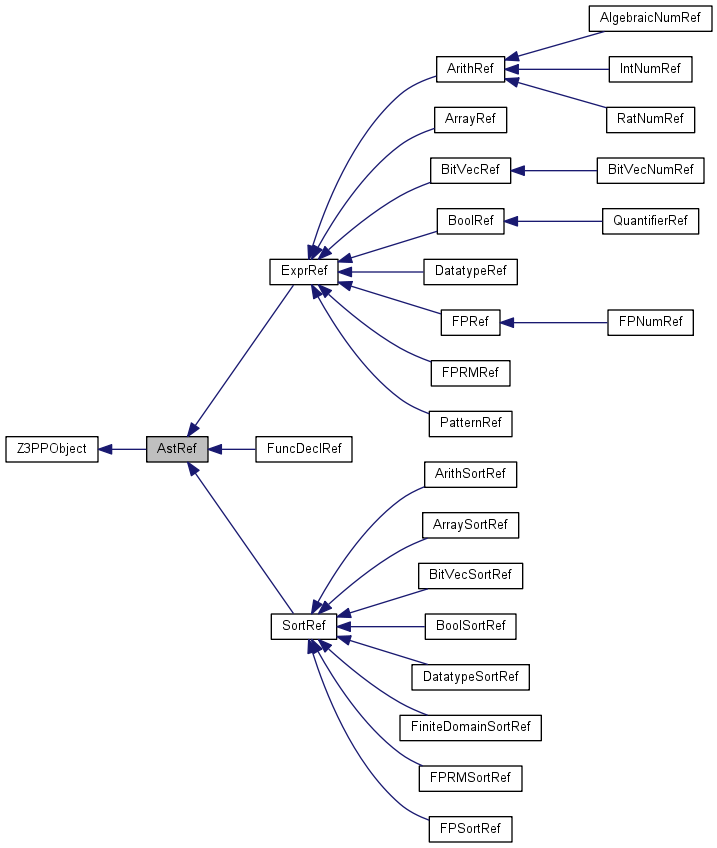
 Inheritance diagram for AstRef:
Public Member Functions | |
| def | __init__ |
| def | __del__ |
| def | __str__ |
| def | __repr__ |
| def | sexpr |
| def | as_ast |
| def | get_id |
| def | ctx_ref |
| def | eq |
| def | translate |
| def | hash |
Data Fields | |
| ast | |
| ctx | |
AST are Direct Acyclic Graphs (DAGs) used to represent sorts, declarations and expressions.
| def __init__ | ( | self, | |
| ast, | |||
ctx = None |
|||
| ) |
| def __del__ | ( | self | ) |
| def __repr__ | ( | self | ) |
| def __str__ | ( | self | ) |
| def as_ast | ( | self | ) |
Return a pointer to the corresponding C Z3_ast object.
Reimplemented in QuantifierRef, PatternRef, ExprRef, FuncDeclRef, and SortRef.
Definition at line 296 of file z3py.py.
Referenced by AstRef.__del__(), ExprRef.arg(), ExprRef.decl(), AstRef.eq(), AstRef.get_id(), SortRef.get_id(), FuncDeclRef.get_id(), ExprRef.get_id(), AstRef.hash(), ExprRef.num_args(), AstRef.sexpr(), ExprRef.sort(), BoolRef.sort(), and AstRef.translate().
| def ctx_ref | ( | self | ) |
Return a reference to the C context where this AST node is stored.
Definition at line 304 of file z3py.py.
Referenced by FuncDeclRef.__call__(), SortRef.__eq__(), ExprRef.__eq__(), SortRef.__ne__(), ExprRef.__ne__(), ExprRef.arg(), FuncDeclRef.arity(), SortRef.as_ast(), FuncDeclRef.as_ast(), ExprRef.decl(), FuncDeclRef.domain(), AstRef.eq(), AstRef.get_id(), SortRef.get_id(), FuncDeclRef.get_id(), ExprRef.get_id(), AstRef.hash(), FuncDeclRef.kind(), SortRef.name(), FuncDeclRef.name(), ExprRef.num_args(), FuncDeclRef.range(), AstRef.sexpr(), FiniteDomainSortRef.size(), and BoolRef.sort().
| def eq | ( | self, | |
| other | |||
| ) |
Return `True` if `self` and `other` are structurally identical.

>>> x = Int('x')
>>> n1 = x + 1
>>> n2 = 1 + x
>>> n1.eq(n2)
False
>>> n1 = simplify(n1)
>>> n2 = simplify(n2)
>>> n1.eq(n2)
True
Definition at line 308 of file z3py.py.
Referenced by SortRef.cast(), and BoolSortRef.cast().
00308
00309     def eq(self, other):
00310         """Return `True` if `self` and `other` are structurally identical.
00311
00312         >>> x = Int('x')
00313         >>> n1 = x + 1
00314         >>> n2 = 1 + x
00315         >>> n1.eq(n2)
00316         False
00317         >>> n1 = simplify(n1)
00318         >>> n2 = simplify(n2)
00319         >>> n1.eq(n2)
00320         True
00321         """
00322         if __debug__:
00323             _z3_assert(is_ast(other), "Z3 AST expected")
00324         return Z3_is_eq_ast(self.ctx_ref(), self.as_ast(), other.as_ast())
| def get_id | ( | self | ) |
Return unique identifier for object. It can be used for hash-tables and maps.
Reimplemented in QuantifierRef, PatternRef, ExprRef, FuncDeclRef, and SortRef.
Definition at line 300 of file z3py.py.
00300
00301     def get_id(self):
00302         """Return unique identifier for object. It can be used for hash-tables and maps."""
00303         return Z3_get_ast_id(self.ctx_ref(), self.as_ast())
| def hash | ( | self | ) |
Return a hashcode for the `self`.

>>> n1 = simplify(Int('x') + 1)
>>> n2 = simplify(2 + Int('x') - 1)
>>> n1.hash() == n2.hash()
True
Definition at line 341 of file z3py.py.
00341
00342     def hash(self):
00343         """Return a hashcode for the `self`.
00344
00345         >>> n1 = simplify(Int('x') + 1)
00346         >>> n2 = simplify(2 + Int('x') - 1)
00347         >>> n1.hash() == n2.hash()
00348         True
00349         """
00350         return Z3_get_ast_hash(self.ctx_ref(), self.as_ast())
| def sexpr | ( | self | ) |
Return an string representing the AST node in s-expression notation.

>>> x = Int('x')
>>> ((x + 1)*x).sexpr()
'(* (+ x 1) x)'
Definition at line 287 of file z3py.py.
Referenced by ArithRef.__div__(), BitVecRef.__div__(), BitVecRef.__ge__(), ArrayRef.__getitem__(), BitVecRef.__gt__(), BitVecRef.__le__(), BitVecRef.__lshift__(), BitVecRef.__lt__(), BitVecRef.__mod__(), ArithRef.__rdiv__(), BitVecRef.__rdiv__(), Fixedpoint.__repr__(), Optimize.__repr__(), BitVecRef.__rlshift__(), BitVecRef.__rmod__(), BitVecRef.__rrshift__(), BitVecRef.__rshift__(), BitVecSortRef.cast(), and FPSortRef.cast().
00287
00288     def sexpr(self):
00289         """Return an string representing the AST node in s-expression notation.
00290
00291         >>> x = Int('x')
00292         >>> ((x + 1)*x).sexpr()
00293         '(* (+ x 1) x)'
00294         """
00295         return Z3_ast_to_string(self.ctx_ref(), self.as_ast())
| def translate | ( | self, | |
| target | |||
| ) |
Translate `self` to the context `target`. That is, return a copy of `self` in the context `target`.

>>> c1 = Context()
>>> c2 = Context()
>>> x  = Int('x', c1)
>>> y  = Int('y', c2)
>>> # Nodes in different contexts can't be mixed.
>>> # However, we can translate nodes from one context to another.
>>> x.translate(c2) + y
x + y
Definition at line 325 of file z3py.py.
00325
00326     def translate(self, target):
00327         """Translate `self` to the context `target`. That is, return a copy of `self` in the context `target`.
00328
00329         >>> c1 = Context()
00330         >>> c2 = Context()
00331         >>> x  = Int('x', c1)
00332         >>> y  = Int('y', c2)
00333         >>> # Nodes in different contexts can't be mixed.
00334         >>> # However, we can translate nodes from one context to another.
00335         >>> x.translate(c2) + y
00336         x + y
00337         """
00338         if __debug__:
00339             _z3_assert(isinstance(target, Context), "argument must be a Z3 context")
00340         return _to_ast_ref(Z3_translate(self.ctx.ref(), self.as_ast(), target.ref()), target)
Definition at line 273 of file z3py.py.
Referenced by FuncDeclRef::__call__(), SortRef::__eq__(), SortRef::__ne__(), FuncDeclRef::arity(), AstRef::as_ast(), SortRef::as_ast(), FuncDeclRef::as_ast(), ExprRef::as_ast(), FuncDeclRef::as_func_decl(), FuncDeclRef::domain(), SortRef::kind(), FuncDeclRef::kind(), SortRef::name(), FuncDeclRef::name(), FuncDeclRef::range(), and FiniteDomainSortRef::size().
Reimplemented in FPSortRef, BitVecSortRef, and ArithSortRef.
Definition at line 273 of file z3py.py.
Referenced by FuncDeclRef.__call__(), ExprRef.__eq__(), Probe.__eq__(), Probe.__ge__(), ApplyResult.__getitem__(), Probe.__gt__(), Probe.__le__(), Probe.__lt__(), ExprRef.__ne__(), Probe.__ne__(), Fixedpoint.add_rule(), Optimize.add_soft(), Tactic.apply(), ExprRef.arg(), ApplyResult.as_expr(), Fixedpoint.assert_exprs(), BoolSortRef.cast(), ApplyResult.convert_model(), ExprRef.decl(), FuncDeclRef.domain(), Fixedpoint.get_answer(), Fixedpoint.get_assertions(), Fixedpoint.get_cover_delta(), Fixedpoint.get_rules(), SortRef.kind(), Optimize.model(), SortRef.name(), FuncDeclRef.name(), Fixedpoint.param_descrs(), Optimize.param_descrs(), Tactic.param_descrs(), Fixedpoint.parse_file(), Fixedpoint.parse_string(), Fixedpoint.query(), FuncDeclRef.range(), Fixedpoint.set(), Optimize.set(), Tactic.solver(), ExprRef.sort(), BoolRef.sort(), Fixedpoint.statistics(), Optimize.statistics(), Solver.to_smt2(), and Fixedpoint.update_rule().
 1.7.6.1